Bible: Old Testament; Jesus
BIBLE: OLD TESTAMENT

298. The Psalms Speak (by George Terhune Peck; 1991)
About the Author—This pamphlet grew out of a course taught at Pendle Hill in 1989. George & his wife, Annie have been members of Stamford-Greenwich (CT), and were founding members of Brunswick Meeting (ME). They spent a term at Pendle Hill and George has written several pamphlets. He is active on the Board.
[Introduction]—Psalms have spoken to many people in the 2,400 years or so since they passed from oral to written tradition. Can we still hear them? Prayer and meditation can help a true seeker find a way back to the psalms, to history, and perhaps a spiritual home. To read the psalms, one may try a more meditative reading. The psalms for me sing of the wisdom of lived experience, being known by God, surviving suffering and grief, risking honest hate, anger, and making penance, seeking refuge, befriending creation, singing praises.
Intimacy with God (See Psalm 139)—In approaching God (vv.1-2), the psalmist sees God 1st in the distance; then God comes closer (vv.3-5). How does the psalmist of #139, & how do we respond to such closeness? [The psalmist responds with: “Such knowledge is too wonderful for me; it is high, I can’t attain to it” (v.6). Later, the psalmist considers the temptation to escape God’s presence, & all the possible hiding places, even in darkness (vv.7-12). How is it that we & the psalmist, find again & again & everywhere, God presence? Once having experienced that presence & peace, it isn’t hard to set aside time each day for a moment of collection.
God has “grabbed us by the gut,” to use a modern translation. God knows our bodies by virtue of having created them from nothing (vv.13-16). Do we accept the universal life force behind all creation? God knows us down to the bottom of our secret selves. Our existence is known in the mind of God, before conception and after death. When in our thoughts we come close to God, we approach infinity. [Awake or asleep, we are still with God] (vv. 17-18). The psalmist ends in a simple prayer (vv. 23-24), asking to be searched, known, and led.
Hebrew poets use parallelism: the same idea is repeated in different words, or one idea & its opposite are repeated. In Psalm 1, follow the godly worshiper as he or she walks, stands, sits, & finally comes to rejoice in creation’s ordered harmony. The psalm has almost no adjectives or adverbs; herein lies its power. Power comes through descriptive use of similes & metaphors. This psalm is in 2 parts: the godly, whose simile is a tree planted by a river; the ungodly, whose simile is wind-blown chaff. The angry judgmental God of Psalm 2 seems incompatible with the biblical message of love, & so a stumbling block emerges for understanding the psalms.
Hatred (Psalm 137, 139:21-22)—It would surprising if poetry composed nearly 3,000 years ago didn’t contain elements that I don’t want to take in at all—much less mediate on. [If we are meant to embrace all of Holy Writ], how can we understand the psalm passages of hate? (139:21-22). The psalmists are at war, passionately involved in the war between good & evil. I have shared the dismay of the singers at the Babylonian exile, their grief, longing, & loyalty to God. Then to be asked to sing (137:1-5). Described by a Jewish scholar as “a dreadful call to vengeance, 137:8-9 tell half the story of the West Bank, the other half being explained by the holy war preached by Mohammed. According to the bulk of Christian teaching, evil isn’t a power set over against God, but an aberration. Grief can lead to hate, but honest recognition of hate can lead back to grief & the capacity for forgiveness & reconciliation; [God & us forgiving God’s children, which are all people]. Humanity at its fullest potential recognizes the aberration of evil, finds the song of redemption and sings it, even in captivity.
Suffering (Psalms 13 & 22)—Suffering is the alternative to hate once there is grief from injustice. Laments or complaints form an important dimension in the psalms and scholars have classified ⅓ or more of the Psalms as laments. They can rarely be tied to a specific sickness or historical event. Laments portray the universal sufferings of humanity then and now and everywhere. Of course, many of us refuse to admit suffering in any form. In this century a new way of looking at suffering has grown up; it is seen as a normal part of the human condition. We are learning to bring our weaknesses into the Light, discharge our negative feelings about them, allowing them to be embraced and strengthened in the Light. [Expressing aggressions and tensions toward inanimate objects is one way of] dumping our garbage of our personal conflicts. Carl Jung’s treatment led people to raise the stresses [of inner polarity] to the conscious level and then, when they had lost their sting, to cast them out, [in order] “to help patients find their structural base again.”
The typical lament of the psalmist follows a progression from complaint (naming tension), through petition (therapy), to praise (release) [e.g. Psalm 13] The 4 different but similar complaints in vv. 1-2 form a fine example of repetitive parallelism by asking how long 4 specific negative conditions will last 4 times. Then there is the petition in vv. 3-4, a request for Light and for awareness. The psalmist ends with a declaration of trust and joy in vv. 5-6, “because he hath dealt bountifully with me.”
Psalm 22 deals with complaints of psychic and physical illness. The “bulls of Bashan” in vv. 11-13 used to strike me as funny, because their slavering seemed as exotic as a lion’s roaring. Sickness can be physical too, as in vv. 14, 15, 17. Both the black humor and the wild complaint can lead us to not take pain personally. As the pain ceases to dominate us, we can turn to God in thanks, as in vv. 24-25: “For he hath not despised nor abhorred the affliction of the afflicted ... My praise shall be of thee in the great congregation.”
Grief (Psalm 130)—When death’s separation occurs, few escape grief. In vv. 1-2, the psalmist speaks from out of the depths. Grief seems to me like suffocation; time stands still; deadness presses down on life. It is like being drowned. Our culture doesn’t encourage grief & the full-throated roar of pain. [I have witnessed such expression in an Italian mountain town. It lasted the entire day, & the next day] the cathedral bell tolled once a minute all day, reminding all how grief drags down time. The next day the widow was herself again, grief purged.
Verses 3-4 make it also a penitential psalm. The psalmist makes no claim of self-justification and casts himself or herself on the love of a forgiving God. Trust has taken the place of argument in verses 5-6. The psalmist is impatient, longing to escape from the weight of grief and the gloom of night. Grief is never an isolated experience. In each individual grief, the community, relives and releases its grief, as in verses 7-8.
Refuge (Psalm 91)—How wonderful it is to be able to seek & find refuge, safety & comfort in God. [I am reminded that Martin Luther, who never backed down, wrote “A Mighty Fortress is Our God].” He may have drawn inspiration from Psalm 91, especially verses 1-4. [I think of verses 5-7 when] I remember in 1945 when I expected to be sent at dawn to the firing squad as a spy. I trusted in God to be delivered—by death or otherwise as God willed. What promises of protection [there are in verses 9-13]! Do I really believe in God’s promises of protection? [There are remarkable instances of being spared throughout history], yet few if any would lay claim to a faith that would protect us from all diminishments. God’s promise is found in verses 14-16, made to you & I. Most scholars believe that the psalmist hoped to live to a ripe old age. [I believe personally that] the important promise is that life isn’t confined to any particular time & space. So to me “long life” means eternal life.
[Refuge (Psalms 121; 24; 46)]—The center of refuge and of greatest holiness was a special place in ancient Israel, Mt. Zion in northeastern Jerusalem. The scribes indicated that Psalms 120-134 were pilgrimage songs. To many of them, Mt. Zion is a symbol: the “city of our God.” “I will lift up mine eyes unto the hills,” starts Psalm 121: 1-4. I still find peace and inspiration in the hills. God shows untiring care for each individual and by a natural transition, for the whole community of “Israel” in verses 5-9. I cherish especially that watchful-ness that blesses my “going out and coming in.” A moment of holiness is dramatically captured in Psalm 24, which opens with “The earth is the Lord’s and the fullness thereof ... (vv.1-6). What follows (vv.7-10) can be a dialogue between the priests and pilgrims. The community as a whole rejoices in God as a refuge. And then there is Psalm 46:10-11, with its verse “Be still and know I am God ... the God of Jacob is our refuge.”
Befriending Creation (Psalms 19; 104)—For everyone who carries concern for heaven & earth, the psalms are a meditational inspiration, a fresh liturgy, a spiritual base for social concerns (Ps. 19:1-6): “The heavens declare God’s glory ... In them hath God set a tabernacle for the sun ... there is nothing hid from the heat thereof.” The psalmist celebrates the rationality and inter-relatedness of all phenomena, “the seamless web of creation.”
Often the stars would speak to me and so I came to know their language. As a schoolboy, I lay down on the football field. I looked up at the stars and the milky way, shining with incredible clarity. To me they declared the glory of God and so did the black spaces in between, for I could barely grasp their immensity. This cosmos was home to me & in it I felt the presence of God. Some environmentalists have accused the “hierarchical nature of Judeo-Christian theology [of removing] human beings from the natural world and placing them in control of it ... We need to see ourselves humbly, as part of the earth, going beyond “stewardship.”
Christianity is the religion of Europe, whose people, animals, plants, insects, & germs altered if not obliterated non-European ecologies [& cultures]. I don’t think scripture teaches that a true steward could be an exploiter. In 19:7-10, the psalmist is talking about natural law, both in the ecological & social dimension. Newton was describing expectable regularities in the physical world while Hobbs & Grotius were doing the same for human relations. We often depart from the enjoyment of serenity and peace, [prompting the questions and concerns of verses 12-13. European settlement of continents show them to be] very bad stewards, having no concern or awareness for the consequences of their actions. Will future generations look back on us and our treatment of the environment with repugnance? “Let the words of my mouth,/ the meditations of my heart/ [my actions with nature]/ be acceptable in thy sight,/ O Lord, my strength and my redeemer (verse 14, with [addition].
Of similar significance to environmentalists is Psalm 104, which contains extended reflections on Genesis 1 & 2. Does or should Adam rule all nature? Is Eve an afterthought? In vv. 1-3, the 1st creation is light. God as creator was & is still a central religious experience, but God’s clothes have changed. To one who worships in the One Creator’s presence, human creativity is only a pale deeply treasured reflection of the divine.
The psalmist centers on God in verses 5-23: “Who laid the foundations of the earth,/ that it shouldn’t be re-moved forever ... Thou hast set a bound that waters may not pass over;/ that they turn not again to cover the earth He sendeth the springs into the valleys/ which run among the hills ... He watereth the hills from his chambers; the earth is satisfied with the fruit of thy works ... The high hills are a refuge for the wild goats; and the rocks for the conies. He appointed the moon for seasons;/ the sun knoweth his going down ... The sun ariseth ... & [the animals lay down in their dens./ Man goeth forth unto his work & to his labor until the evening.” Should we Christian be less respectful & less humble in creative evolution’s presence [than these early worshipers of God]? Earlier commentators attributed the prominent position of water in the psalmist’s world to Palestine’s dryness, but present-day residents of wet climates have learned to prize water just as highly. Like the psalmist, we are inclined to be most grateful for the gifts which the Creator gives us from our fields. [On the other hand, our unparalleled manipulation of nature, thus tearing] the seamless web of creation, presents the main threat to the balance of nature. In verses 24; 27-29; 31-34, we recognize God’s works, that God provides for all of us, & we end our meditation with praise & thanks: “O Lord, how manifold are thy works!/ in wisdom hast thou made them all;/ the earth is full of thy riches ... [Whatever] thou givest them they gather ... The glory of the Lord shall endure forever;/ the Lord shall rejoice in his works ... My meditation of him shall be sweet; I will be glad in the Lord.”
Praise (Psalms 42; 100; 23—Praise is the most frequent and strongest theme in the psalms. The soul [seeks intimacy], survives suffering and grief, risks hate, makes penance, seeks refuge [from God, then with God], befriends nature, loves and is loved by God, sings praises. One does not have to slog through [all the above] in order to earn the blessing of God’s love. God’s grace just comes—unexpected, unplanned, and unsought. Then it is sought again often in the silence of worship. The problem is that we forget, and succumb to the temptation to believe in a reality other than God, [an external “reality”] of sickness, poverty, or death.
Most often psalmists express God’s love in God’s “name,” “law,” “house,” “mercies,” “goodness,” & “lovingkindness.” The burning affectus of Augustine, the daily companionship of humble Francis with God’s love, the [tendering] & tenderness of early Quakers in God’s love. Jewish and Christian devotion is full of desire, as in Psalm 42:1-3. It is not possible to give out love or joy and have less, for these are gifts that feed upon themselves and grow ever stronger. “Make a joyful noise unto the Lord all ye lands./ Serve the Lord with gladness ... For the Lord is good;/ his mercy is everlasting;/ and his truth endureth to all generations.” [From Psalm 100].
In Psalm 23 there’s no striving, no petition, but only simple & direct statement of fact. The psalmist rests in assurance of a loving presence now. In reading these familiar verses, we may be tempted to slide over them as though they were a well-worn formula. “The Lord is my shepherd” conveys caring simply & beautifully. [God’s love] isn’t the reason most of us think we shall not want (vv. 1-3) [We work &] spend [lots] of time to keep it that way. May I, & others, sometimes reach faith that the psalmist states as a fact & so find my soul restored. “Yea, though I walk through/ the valley of the shadow of death,/ I will fear no evil;/ for thou art with me” (v. 4), as an affirmation has brought solace to the survivors at a funeral service. God is our host & hostess & lays the table for friendship in verse 5. While we start out as enemies or strangers, we become friends, children of God in common by the main course’s end. The psalm ends as we are gathered in our cosmic home in verse 6: “Surely goodness & mercy shall follow me/ all the days of my life:/ & I will dwell in the Lord’s house forever. Amen.
http://www.pendlehill.org/product-category/pamphlets
www.facebook.com/pendlehill?fref=ts

438. A Seal upon the Heart: Quaker Readings in the Song of Songs (by Michael Birkel; 2016)
About the Author—Michael Birkel teaches in the Religion Department at Earlham College. He wrote the Pendle Hill Pamphlet #398 The Messenger that Goes Before: Reading Margaret Fell for Spiritual Nurture and edited #406 The Mind of Christ: Bill Taber on Meeting for Business. In his book Qur'an in Conversation, Muslim religious leaders and scholars grapple with interpretations of key suras of the Qur'an.
[Introduction]—[Song of Songs 2:10-12 cited] Old love songs never die, not the good ones. Good love songs arouse memory and imagination. [Otherwise they would only be history and information]. Likewise, people often read the Bible to discover a living God, not a historical, ancient deity. Why should a biblical collection of love poems be of interest to anyone today? Early Friends spoke Bible. Scripture provided a language for their inward encounters. Exploring how early Friends read the Song of Songs can open new possibilities for understanding their experiences and for fresh encounters with the Spirit that inspired them. These candid, sensual, poetic love lyrics have attracted lovers of God across the centuries in church and synagogue, Earlier Friends found in the beauty and intensity of these verses a fitting dialect to speak of their experiences of divine presence. Contemporary biblical scholars understand the book's original intent as a playful celebration of love; pious readers have interpreted its message symbolically.
The Song as a Love Poem—From the famous opening lines, spoken in the woman's voice, the poem is passionate. The lovers speak of each other with metaphors drawn from the natural world. The delight of this text is that it is suggestive in the extreme, but it is never more than that; it is playful, yet reticent. This is a book for grownups, not merely in its adult subject matter, but also in its grownup way of avoiding voyeuristic indulgence. [Song 1: 7, 9, 13-14 cited]. In the Song of Songs the lovers tease each other, and thus the reader, relentlessly.
One of the verses just cited mentions En Gedi, which is a fertile oasis in the Judean wilderness, an eruption of beauty in the desert. Vineyards appear in the text, but there is no evidence of them at En Gedi, so this may be a subtle allusion to the woman's body. [Being too concerned with precise interpretation] is to risk spoiling its beauty, which relies so much on its ambiguity. The poem resists precision. Their poetic description of one another's beauty draws on the senses & invites the reader into a world of sight, sound, smell, & taste. She is a locked garden, filled with aromatic spices (Song 4:11-16). Many readers find the high point of the Song's celebration of love in the following verse: Set me as a seal upon your heart,/ as a seal upon your arm;/ for love is strong as death,/ ardor is fierce as Sheol./ Its flashes are flashes of fire,/ a godlike flame.
The Song as Scripture—Love and romance appear elsewhere in the Bible, but nothing else compares to the Song of Songs in quality or quantity. How did the Song of Songs make its way into the Bible? It got into Scripture by virtue of being read allegorically. Other biblical passages inspired the concept of the church as the bride of Christ, so ancient and medieval interpreters found it natural to embrace the Song as a thesaurus of divine love. Origen, Bernard of Clairvaux, John of the Cross, Teresa of Avila, and others read it as an allegory.
It is possible to interpret the Songs of Songs as love song and allegory. The Song evokes a spirit of playfulness among its readers and commentators, and provides ample images and challenges to its readers. Christian commentary on the Song flourished as early as the third century in the writings of Origen of Alexandria. The 12th century monk Bernard of Clairvaux composed 86 sermons on the Song of Songs. Since "soul" in Latin and other European languages is feminine, any human reader could identify with the female voice in the Song.
The Puritan Geneva Bible describes the Song this way: "Solomon, by sweet and comfortable allegories and parables describeth the perfect love of Jesus Christ, the true Solomon and King of Peace ... The faithful soul of his Church ... [is] his spouse, holy and chaste." [Puritan may have had] suspicions regarding intense, individual spiritual experience. Early Quaker interpretation would speak of divine love for both the individual and the community. Jeanne Guyon, a French Catholic Quietist, describes the beloved's kiss as a spiritual marriage. In the intimate union of the self with God, the soul is "so dissolved, rendered nothing, and dispossessed from itself that it can without hindrance flow into God ... the drop has become the sea, though it always remains a tiny drop."
The Song of Songs among Early Friends:[Isabel Fell Yeamans]—Early Quakers did not have a tradition of composed sermons. Neither did they develop a tradition of [orderly] commenting verse by verse on biblical texts. Wary of such practice and of allegories, early Quaker use of biblical texts typically focused on direct spiritual experience. Quaker writings seldom demonstrate the sustained attention on a single biblical text necessary for a dedicated commentary. An image from one biblical source evoked or aroused the memory of a similar image from elsewhere in scripture, resulting in "commentary by juxtaposition."
Isabel Fell Yeamans was one of Margaret Fell's illustrious daughters. Isabel's writings exemplify this associative method of reading the Song of Songs; she urges her readers to welcome the inward Christ. For Isabel, [the passage where] the young lover asks the night sentinels if they have seen her beloved, and then is beaten, keeps searching & is reunited with her beloved, describes the experience of early seekers who sought counsel from those guarding the conventional church. [They were told] that God was to be encountered in the church's external rituals, which many at that time found to be lacking [in spiritual nourishment]. [Besides physical abuse], Isabel describes a spiritual abuse. It felt like a beating when trusted clergy denied direct [access to God's] radically transforming power. Early Friends passed beyond the guardians of the state church & found their Beloved.
[Early Quakers believed that the prophet Joel's prediction of a pouring forth of the Spirit upon women was fulfilled in the Acts of the Apostles & in their own time. Isabel writes of this, juxtaposing Joel, Psalm 71:17, Revelation 3:20, and Song of Songs 5:2 in the process]. She refers to the watchmen, writing: "Come, you that have been enquiring of the blind watchmen of the night. I will tell you where we have found the beloved of our souls ... They smote us and wounded us, but blessed be our God forever, who turned us from them, to the light of Christ Jesus, which gave us knowledge of our beloved, and directed our feet into the right way." The soul's beloved was inwardly revealed, not found in empty ritual that did not satisfy the soul's deep longing.
The Song of Songs among Early Friends: [John Burnyeat, William Smith, and Others]—John Burnyeat used "we" language rather than first-person singular because he was speaking of a collective experience in 1653. He applied the language of the Song of Songs explicitly to the group experience of meeting for worship. He offered an account of his convincement. Biblical references in this selection include: Song 1:2-3, 4:16, 6:2; Psalm 23; Leviticus 2:2, 6:15; Colossians 2:2 3:14, [and God in the Garden of Eden].
[Examples follow]: "& thus being gathered ... our shepherd taught us, led us forth into green pastures, where we did feed & rest together with great delight ... Our spirits as oil, frankincense, & myrrh were offered up as incense, when not a word outwardly in all our assembly has been uttered. & then did the Lord delight to come down into his garden, & walk in the midst of beds of spices & cause [the winds to blow] ... Thy name is as ointment poured forth, therefore do the maidens love thee ... & growing thus into this experience of the goodness of the Lord & divine power in assemblies, we grew in strength & zeal ... knit together in the perfect bond of love." Such exalted language was not rare among early Friends.
Sarah Blackbarrow, an early Quaker writer, [weaves together Song of Songs & Proverbs to come up with]: "A love there is which doth not cease, to the seed of God in you all, & therefore doth invite you...to return into it, that into Wisdom's house you may come... All of you who thirst after your beloved, come into Wisdom's house ... love truth & its testimony... be embraced of my dearly beloved. Love is his name, love is his nature, love is life."
Writing in the shadow of Margaret Fell's Peace Declaration in 1660, William Smith wrote on the peace testimony in which his chief scriptural text was from the Song of Songs 2:4: "[There is a birth which is] that of God ... And the Father spreads his love over it like a banner, by which it is protected and preserved in its growth and increase ... And their weapons are love and patience, by which they overcome."
Dorothy White, the most prolific woman writer next to Margaret Fell, carried on this ecstatic turn into the 1680s. Dorothy wrote in a prose so highly dense with biblical imagery that the fig tree of Song 2:13 is one with the fig tree in Matt. 24:32-33. The garden of Songs is also the garden of Is. 5:11 or Jer. 31:12. [Other verses she uses in juxtaposition] include: Joel 2:23 (possibly with James 5:7); Lam. 3:22-23; John 4:14. Dimmer echoes of other passages may also be in her The Day Dawned Both to Jews and Gentiles ... A century later in his Journal writing, John Woolman drew on many biblical sources [e.g. Numbers, Hebrews, Romans]. In recounting an experience of encountering God as justice and righteousness, John Woolman turned to the ecstatic expressions from the opening verses of the Song of Songs [on p. 177 of Moulton's edition of Woolman's Journal,].
The Fragrance of Desire/To the Other Side of Words—The desire for God can be as elusive & as subtle as a blooming spring flower's scent. The experience of divine repsence can be like a fragrance. The faintest memory of it arouses desire, like a fragrance. Desire is transformed into consent to what cannot be adequately described, or even known. This consent becomes a relinguishing of expectation, in order to be present to the spiritual experience. Even the person experiencing this unutterable sweetness can seem to dissolve. Awareness of the boundaries of selfhood can grow faint. All that remains is the enrapturing fragrance, itself melting away.
George Fox certainly made encyclopedic use of the Bible, including the Song of Songs. Concerning silent meetings: "The intent of all speaking is to bring into the life,/ and to walk in, and to possess the same,/ and to live in and enjoy it, and to feel God's presence,/ and that is in the silence,/ not in the wandering whirling tempestuous part of man or woman,/ for there is the flock lying down at noon-day,/ and feeding of the bread of life, and drinking at the springs of life, when they do not speak words;/ for words declared are to bring people to it,/ and to confess God's goodness and love,/ as they are moved by the eternal God and his spirit."
What in the Song of Songs is a request for a lovers' rendezvous becomes a request of the soul's beloved. In sum, George Fox takes this phrase from the Song of Songs that is a tender hint at a loving reunion and applies that loving intimacy to meeting for worship, where the gathered community lies down, resting in silence, to receive nourishment [in a collective experience]. Fox's words point to the silence on the other side of words; he alludes to the Song of Songs for this purpose.
What kind of language is capable of pointing beyond its own limits and of encouraging the mind to be transformed by wonder? The radiant natural world becomes, in the world of Song of Songs, a vocabulary for amazement. The natural images ... employed by the lovers to convey their [unfulfilled] longing ... is the raw material out of which the vision of the soul's beloved is crafted among its readers. The language of desire in the Song of Songs has for centuries beckoned lovers of God into the silent wonder beyond.
Queries—Do you experience the Song of Songs as a "celebration of the holiness of human love," read it allegorically, both, or something different? Why is or why isn't the Song of Songs an integral part of the Bible? How good is human love at being a metaphor for intense spiritual experience of divine presence? What metaphor would you use? How does your description of your worship experience compare with that of early Quakers'? How does spiritual love & longing similar to & different from the love between persons? How would you describe the relationship between love & Quaker witness for peace? Why is it significant that the "tender hint at a loving reunion" is a collective experience rather than a private one?
http://www.pendlehill.org/product-category/pamphlets
www.facebook.com/pendlehill?fref=ts

133. The Eclipse of the Historical Jesus: Haverford College Library Lectures, April 1963 (by Henry J. Cadbury; ‘64)
Foreword—[This is from 2 Haverford College Library Lectures in April of 1963]. It was intended to provide an untechnical audience with an untechnical account of recent currents and counter-currents in the studies [centering around the “theological” and “historical” Jesus]. 50 years ago on this campus a group of students approached me and said: “We believe something of importance happened in Palestine in the 1st century. We want you to tell us what it was.” [I choose “eclipse” for the title], for eclipses in the sky are not permanent and are rarely total. There is usually at least the penumbra or corona.
Albert Schweitzer’s Quest and After—[Over] 50 years ago [1906], a young Alsatian theological student [named Albert Schweitzer] wrote The Quest for the Historical Jesus. He later became a medical missionary for 50 years at Lambarene in Equatorial Africa. The term “historical Jesus” is not a new or unique one. What any man was actually like may be obscured in several ways. 1st, there is sheer lack of data. There is almost no record of Jesus outside our 4 gospels; 3 overlap to such an extent as to reduce their contents by half.
2nd, A historical person may become obscured by the growth of unhistorical data about him. 3rd, an almost unique disturbing fact has been at work. He has been believed to have become alive again and to be alive. [In the case of the fusion of a human being with a supernatural figure, the historian wishes to separate out at least temporarily the 2 elements fused in Jesus in the interest of doing justice to each. A suitable terminology is hard to come by. The single words “Jesus” and “Christ” are often used [to distinguish the 2 elements].
Schweitzer’s Quest was a laborious, brilliant review of efforts [from 1778-1902, spanning historical, aesthetic, literary, scientific, and philosophical approaches] to write the life or interpret Jesus’ career & recover even his self-consciousness. Schweitzer says: “The world had never seen before, and will never see again, a struggle for truth so full of . . . renunciation as that of which Jesus’ lives of the last 100 years contain the cryptic record.”
4 generalizations will be useful as we follow on from Schweitzer’s time to our own day. 1st, the quest has been marked by a progression from one phase to another, [following] one another by an unconscious logic. 2nd, habits of thought in other fields both religious and secular affected the approach. 3rd, each scholar who attempts a solution brings to the subject his own presuppositions or those of his background or environment.
It shouldn't be supposed that Schweitzer escaped this danger entirely. [After admitting that Jesus was mistaken about his expectation about the Kingdom of God’s imminent advent, Schweitzer departs from his own logic &] summons the reader to an orthodox type of Christian loyalty in his conclusion. 4th, men have started out with the [desire to recover a Jesus that would have greater meaning in today’s world]. This adds a motive other than pure historical inquiry. This kind of interest has intensified rather than relieved the eclipse we are talking about.
[Schweitzer’s life after the Quest includes 50 years as medical missionary in Africa, & concerns for ethics, civilization, and even for the world problem of a suicidal cold war]. His views on the historical Jesus are said to have changed, but there has been little published by him on them. [Like an audit that reveals] bankruptcy his book merely reports a condition of affairs for which he was not responsible. [Theological viewpoints like “realized eschatology” were used to explain away Jesus’ “mistake.” [American scholars began another phase known as “the social gospel,” which pictured Jesus as] a humanitarian and reformer, prophet of an ideal social order.
In Germany some pursued the hypothesis that Jesus never existed at all. If miracles are elsewhere a part of mythology, why not in the gospels too? All contradictions and limitations of our knowledge about him do not require that conclusion, [which] survives east of the Iron Curtain and appears to be widely accepted in Russian atheism. They use some Western scholars’ respectable theory that Jesus never lived at all to support their claim. Another approach used after Schweitzer published his Quest was the psychiatric one. Schweitzer refuted the diagnosis of other writers that implied that Jesus was mentally ill.
More important & durable & more widely accepted even until today was the development of “Form Criticism.” [By isolating] the uses to which the community put [the material] in its oral stage, it hopes to recover Jesus’ original acts & sayings. Form criticism concluded that the separate units even within 1 gospel had had independent transmission & use. Hence there are what I have called “Mixed Motives in the Gospels,” which makes identifying & isolating early Christian alteration of primitive memory extremely difficult. Form criticism hoped to recover the historical Jesus by identifying the early church’s interests. [Instead of finding the historical layer we are looking for, we created another one. By allowing for it, we hope to arrive at what we are looking for.
Influences of Recent Theology—[Form criticism transferred interest from the Jesus of history to the Jesus in early Christian thought]. What the early Church thought of Jesus is a matter of evaluation & interpretation; its concern was increasingly less historical. Even if the central figure in theology & history is the same, they become in a sense rivals for intellectual attention. As long as the Jesus of history was the goal, the pursuit was only unconsciously affected by considerations used in theology. [Whether rejecting] Jesus’ existence or constructing a social gospel, scholars welcomed an objective discovery as beneficial for the modern world.
Theology, however, thinks the historical determination of Jesus’ own existence or character is relatively unimportant. The Jesus of theology begins at the point in time where the Jesus of history leaves off. The theological approach has an independent appeal, and it tends to overshadow the other interests. The purely literary study of the gospels emphasized the interpretive role of the early Church in attempting to distinguish primitive Christianity from Jesus himself. Form criticism rightly recognized that the units of material had had each a separate history so that they were detached from any possible reconstruction of chronological order. In all 4 gospels there is a large proportion of interpretation as compared with sheer history.
The primitive message [or kerygma] about Jesus was thus understood to have eclipsed Jesus’ life & teaching. [Isolating] the early Church’s message [only helps us if taking it out] leaves us with a purer residue in which to find Jesus. The interest in kerygma was contemporary with a significant early stage of the ecumenical movement. The kerygma could provide a common basis for the modern sects in Christendom. What was Jesus thinking? What Jesus did & said are indeed reported; for what he thought one can only read between the lines.
There has also been an increasing interest in recent years in what is called biblical theology. In biblical theology, the Bible isn't treated as having theologies; it isn't treated as development in the human sense, but as sharing a single viewpoint [in OT and NT], that of “salvation history.” It excludes any books not considered canonical. Bending primitive theology to meet our present needs or adjusting ourselves [to what the Early Church believed (i.e. modernizing the Bible or taking ourselves to the time and practice of the Early Church isn't proper use of biblical theology]. The connection of biblical theology with the historical Jesus isn't easy to define. There is something unparalleled in a historical figure becoming so important a figure in the life of a major religion.
Theology is a dramatic representation intended to describe religious experience, a narrative play. The subject matter may be the supposed predicament of the human beings and the imagined intervention of the supernatural beings. Humankind’s predicament is one of being in danger of disaster; they are offenders in the sight of God. Much of the ideological background is inherited from the OT thought, to which Judaism added angels late in its development, while demons were a very real feature of contemporary Gentile mythology or psychology. What did the inclusion of a historical character mean for the drama? What did it mean for the historical understanding of Jesus? God intervened in events in history, but Jesus was a more significant embodiment of that intervention. Tying the drama to a historical figure prevented it from becoming complete mythology.
Already in the earliest Christianity theology showed a tendency to use [a kind of historical fiction]. It wanted to have whatever advantage history could give its drama but did not [worry much about] actual historical details. Modern biblical theology shows a continuation of the desire to enjoy the assets of historical anchorage without too much concern for [finding the actual Jesus]. [Even for Paul] Jesus is a partly a super-historical figure.
So in the whole early Christian kerygma, the dramatic rather overshadows the historical. Christianity has often felt it necessary to reassert the historicity of Jesus, his human actuality. The features of creeds and the human element in the Synoptic Gospels appear to be a reaction against extreme mythologizing. The Christo-logical discussions of subsequent centuries were not based on historical evidence but on philosophical deductions for the mere premise of the incarnation.
Theology tends to deflect attention from the quest of the historical Jesus; theologians regard their own approach as more important. They claim that the Jesus of history has never been central in Christianity. [It is more important that Jesus Christ confronts us in the kerygma than that we go back to the historical Jesus]. Yet the historians are not prepared to surrender their position; it remains for them a respectable interest. A Christ who is merely a figure of history is not more useless than is a figure in the imaginative drama of theology unless that can be updated. For Quakers the Christ was not a phenomenon of Jesus’ lifetime only. The Light of Christ had been at work in Jews and even pagans before ever Jesus was born.
Biblical theology itself admits that without interpretation it is unsuited to present needs. Why, if we understand what are our problems today, should we bother to connect them with so arbitrary and fanciful a structure as traditional theology? One suspects [that adherence to biblical theology is] a carryover from typical Protestant emphasis on the authority of the Bible and even from the dogmatic formulation of the creeds. For modern use theology needs to be purged of myth. Some persons fear that theology will demythologize and de-historicize the whole structure of orthodox theology. [Both] the actual denial of Jesus’ historic existence and extreme revamping of redemption history obscures the Jesus of history.
The present debate is being shared internationally. And there is change taking place. [The theologians Barth, Heidegger, and Bultmann have shifted their theological positions from what they once were]. The biblical theologians are reluctant to associate the kerygma of the church with the historical Jesus, except as result and cause. The earliest appraisal by Christians may have differed from what Jesus seemed like to himself, or from what we would have found significant. The historian should strive to be more objective in spite of the difficulty of being so. There is tension between two camps, but the tension may not be unprofitable. I am not unprepared to live with this tension, nor hopeless about the future course of inquiry and analysis.
I find the quest of the historical Jesus a challenge to curiosity and also to integrity as a historian. I give it as my judgment that Jesus was a historical character. The probability of his existence does not make probable all the gospels record, nor does the improbability of some features throw doubt on his existence. [The views presented in the Bible on the end of this age] probably goes back to him. His ethical interest with his somewhat radical insistence on it is I think another historical feature in the oldest gospels. The area of most obscurity is the self-awareness of Jesus. His apparent sense of authority may not have been a prominent element in an otherwise extrovert personality. But after all I must admit how much we cannot know.
http://www.pendlehill.org/product-category/pamphlets
www.facebook.com/pendlehill?fref=ts

441. Making a Portrait of Jesus (by John Lampen; 2016) About the Author—John Lampen has been a trainer and consultant in creative response to conflict in Northern Ireland, Africa, the former Yugoslavia, Soviet Union, and Great Britain. His previous Pendle Hill pamphlets include: Findings: Poets and the Cross of Faith (#310, 1993); and Answering the Violence: Encounters with Perpetrators (#412, 2011)
[Introduction]—My mother was an artist. She would do portraits of someone who had died and whom she never met, using photographs and discussions with family members. I have tried to do something similar in making this portrait in words. The teachings I received in childhood about Jesus never gave me a sense of living reality. [My own adult reading of the records revealed] an extraordinary man who was very different from what I had expected. I share with you now the Jesus I now respect and try to follow.
There are guidelines to help us decide what we can honestly accept in the records about the historical Jesus, what is acceptable & what is questionable; everyone will evaluate the evidence differently. I see Jesus' public mission as going from autumn of 28 CE (AD) to April 7, 30, 18 months. In April of 29, the people tried to get him to lead a revolt against Roman occupation. Jesus [broke off his mission] & withdrew into hiding to rethink his mission; the message hadn't been understood. He emerged a sadder & wiser man who was determined to take it to the national leaders in Jerusalem. In late March he challenged authorities with a "royal entry" into the city & a physical attack on the commercialization of the Temple worship. He was arrested & put to death on Friday April 7th. A few days later the rumors began that his followers had seen him alive.
I have come to see that, whatever the value of an "all-powerful, all-knowing God" image, this figure could not be the man from Nazareth as his friends, followers, family, and enemies knew him; you will not find the theological Christ in these pages. The Jesus here was intensely alive. He had a carrying voice, a Galilean accent, and remarkable eyes; he could be passionately angry; his humor is unmistakable. Rembrandt's Jesus was ordinary looking, but had a faint glow, visible only to those who have eyes for whatever is special in daily encounters.
Part One: A Portrait of Jesus—Jesus' moral teaching: Christianity's compassion for the weak, vulnerable, and oppressed springs from the behavior and words of Jesus. [The genius of] his moral teaching is found as much in his deeds as his sayings. With Jesus, the cause of physical disability became "so God's power might be displayed in curing him." The "rabble" included all the oppressed, despised, "contaminated," probably the majority of society. Jesus told them they were lucky to be free and innocent of the temptations of money and prestige.
Jesus refused to meet expectations. He identified the pressure points where traditional authority [of family & religion] is most likely to be oppressive. He broke petty prohibitions, & said the Law was made for our benefit—nothing else. He attacked contamination taboos, the gulf they created between the righteous & the impure, and the victimizing of women. He healed women, [and showed great compassion toward them]. He was sensitive to the way men discriminated against women, and stood up for their rights. He also championed children. In the people of Nazareth's eyes he was an illegitimate child; they called him "Mary's son," rather than Joseph's.
Jesus told his followers not to use violence, but his advice has been misunderstood. The "turning of the other cheek" is explained by Walter Wink as follows: "The person who turns the other cheek is saying, 'Try again. Your 1st blow failed to achieve its intended effect. I deny you the power to humiliate me. Your status does not alter [my humanity]. You cannot demean me.' Such a response causes great difficulty for the striker."
Jesus founded not a church but a group of friends who ate together. [He started with an exclusively Jewish focus; his people rejected the call, while some of the foreigners he met impressed him with their trust and spiritual insight. A Gentile woman turn the other cheek at Jesus' insulting refusal to help with "Even the dogs under the table eat the children's scraps." Whether she startled him or made him laugh, I think this was a turning point in his thinking and teachings about women and pagans. Jesus told us to love as indiscriminately as God did. If we refuse to recognize the enormous generosity and love that fill the universe, we cut our selves off from it.
Jesus' Politics—Why was Jesus' revolutionary, unpolitical message considered then and still now considered] dangerous? Jesus' era wasn't one of universal peace. The people reacted differently to Rome's presence. Saducees (religious elite) collaborated with Rome [in order to have influence] & minimize the threat to religious freedom; Zealots & Sicarii promoted violent rebellion; Pharisees [isolationists] reacted with strict cultural & religious separation from foreign influences. Some Pharisees befriended & warned Jesus; some preached a message like his own. Other Pharisees' religion was contained in a rulebook & exclusiveness; It made them proud & lacked compassion.
"Iscariot" [Judas] is thought to be a corruption of "Sicarius," the terrorist group; Simeon was a Zealot. Nathaniel was "a true Israelite" with traditional values; Philip had a Greek name & Matthew was a tax collector. Jesus' entry into Jerusalem was as a king who banishes war's weapons [and brings peace]. He wept over the fate awaiting Jerusalem after rejecting his message. He rejected the Saducees dishonest compromise, and the Pharisaic quest for purity. Christianity at different times has embraced each of the paths he rejected.
[System's Power vs. Love's Power/ Jesus Reflects on his Message]—Jesus isolated himself from influential parties; nobody stood up for him. He saw that this world's kingdoms and its rulers exert the system's power over people; God's kingdom exerts Love's power in serving each other. The contrast is shown below:
System's Power Love's & Truth's Power System's Power Love's & Truth's Power
Control Freedom Status, class, caste Equality
Compulsion Nonviolence Doctrine Inquiry
Society Community Judging Acceptance
Hierarchies Servant Leadership Reward/ Punishment Forgiveness
Segregation Inclusion
He questioned the law, criticized Temple worship and priestly authority, taught universal forgiveness [in place of] atonement and sacrifice. He denied the clear-cut distinctions between orthodox and heretic, Jew and pagan. If a charge of blasphemy could be proved, Jewish law prescribed the death penalty, which was not imposable under Roman rule. It was convenient to get the Roman governor to order the execution.
[It wasn't a trial with the Sanhedrin, but] an informal examination, [to see if they could] concoct charges that Pilate would take seriously. Even though Jesus would not deny being the Messiah, this was not blasphemous under Jewish law. It did satisfy Pilate, so that Jesus was dispatched the same way as other trouble-makers [& would-be messiahs]. Why did Jesus not save himself from crucifixion? He knew that the mission to Jerusalem was likely to end in his death.[He had to deal with public expectations of a victorious messiah who would drive out the Romans and establish God's rule over Israel].
[Jesus had to isolate himself] to ponder why his message of peace had been so misunderstood; Jesus had no ambition to lead an insurrection. His conception of messiah was based on Isaiah's suffering servant—a nonviolent witness to the truth who was prepared to suffer. He didn't welcome his fate; he quailed at it. But he would not run away. So long as people keep forging the next link in the chain, the violence continues; peace is merely a short period of calm imposed by whoever, for the time being, is stronger. Each time a violent chain of pain and death is ended, the kingdom of God is enlarged. Jesus refused to forge the next link of hatred and revenge. By absorbing the evil and forgiving its agents, he trusted he could bring it to an end.
Jesus' Spiritual Life—Jesus & his community believed in a personal God who should be respected, feared & obeyed, the Lord of history who rules fates of nations & holds them accountable. Jesus had a personal experience of God; he expected others to share it. He felt that emphasis on God's nature was in the wrong place. The idea that God makes demands on us for God's own satisfaction is wrong. We are to refrain from anger [for our own sake]; anger corrupts us inside. God's Kingdom is a loving, forgiving community, whose members rejoice in serving one another. Something hidden [in this Kingdom that is here & not yet is working away; yeast is rising, a planted seed is growing]. It's a mistake [to care nothing or] care too much for ourselves. We must live in trust that we can cope with a good or bad tomorrow, & trust in a Father who knows what we need.
We have to remember that this advice isn't from someone with a comfortable home & income. Jesus assured his audiences that they might suffer; they wouldn't be tested beyond what they could bear. Jesus was concerned with & even commended pagans for faith in him that was trust in him & not the Church's "test of faith." He was concerned only with the religious faith of people who parade their beliefs but don't live up to them.
Jesus' prayers were a [human/ divine] dialogue, something that flowed into action, & then back into prayer. He used his worship to receive guidance, awareness of God's will on what he should do next. The "repenting" Jesus called for meant "changing your mind," changing your outlook, seeing things with new eyes. Jesus doesn't prescribe confession, tears of repentance, acts of penance [in exchange for forgiveness]. It is repaid by forgiving others. Matthew's references to fear of punishment, & the decreasing emphasis on it in the other 3 gospels tells us more about the preaching of Matthew's church than Jesus' message. Christian life depends on the practice of love. Love to God, love & forgiveness to other people is without limits & isn't dependent on good fortune or friendship. We are to serve without setting limits, for it is by forgetting status & serving others that we qualify as Jesus' followers. There must be no limit to surrender of our selves.
Part 2: The Evidence—[How is picturing Jesus & ourselves radically as suffering servants in God's Community/ Kingdom different from the First Day (Sunday) school picture we were given]? I now want to explain the evidence I have chosen as honestly and objectively as I can. What happened in the 40 years between when Jesus died and when the earliest of the surviving gospels were written?
Roughly 30-70: According to a majority of scholars, each Christian group had memories of Jesus sayings & stories; favorites took on a set form. Those used less often were imperfectly remembered. Those concerned with Jewish tradition interpreted differently from largely non-Jewish congregations. They were shared by word of mouth rather than by reading. By 50 CE (AD), many eyewitnesses had died, & the 2nd generation was getting old. Missionaries needed collections of Jesus' teachings for their converts. Scattered communities combined & edited memories, which resulted in a sayings collection called Q, & the original version of the Gospel of Thomas. Written accounts of Jesus' trial, death, & resurrection began to circulate.
Romans Destroyed Jerusalem (70 CE)—The narrative gospels were compiled from all of sources that existed by that time. After Jerusalem's authority vanished, churches that remained within Judaism found themselves in sharp conflict with contemporary Pharisees about which was the authentic guardian of Jewish scriptures. Pharisees had Jewish Scripture, so the Christians needed their own books that witnessed to Jesus' identity. The gospel authors' different concerns & points of view influenced what they selected.
In one of its Christian forms, Gnosticism claimed that Jesus only seemed to be a person who could breathe, suffer, & die; he was really the divine spirit of understanding sent to save us by teaching secret doc-trines. The Coptic Gospel of Thomas is an example of Gnostic writings. There was more than a century of confusion and controversy. Our present-day gospel were not "certified until the beginning of the 5th century.
5th Century Establishment of the Canon to 1450 CE (AD; 1st Printed Bible): All the early copies of Scriptures we have contain slight variations. Some errors are simple, some deliberate. Sometimes what Jesus "ought to have said" was inserted. The invention of printing made a standard text possible.
[Genuine Material and Evidence of Tampering]—I believe what we have is mostly genuine material with some evidence of tampering. When I see how closely the manuscripts agree, I greatly admire the faithful care of early scribes. The ancient copiers used no capital letter, word breaks, or punctuation. You will see that gospel writers put incompatible explanations of what Jesus meant into his mouth. We cannot be sure that the sayings used were said only once, or placed in their original context.
How are we to assess the complicated mixture [of different sources, contradictions, selective quotes placed in unoriginal contexts, and different timelines, church agendas, preaching and concerns which sometimes pass as "sayings of Jesus?" Matthew's readers were Jewish, so he overstresses points where Jewish prophecies seem to be fulfilled. If Matthew adapted his account to fulfill prophecies and create parallels, how & where did he do it? He groups Jesus' sayings in 5 large blocks, thus mirroring the Torah. He alone emphasizes punishment, and reflects hopes the Jews can still be persuaded about the truth of Jesus' mission to them
Mark has a lively style, writing in blunt, unpolished, eastern-Mediterranean Greek. His is the earliest & least sophisticated gospel; his account is closest to the pre-Easter Jesus; I use it for Jesus' life chronology. Mark's mission account lasts 18 months. Matthew & Luke frequently omit details of Mark's account. In Luke, Jesus 1st offers the Jews salvation; it's for everyone. He brings out Jesus' attitudes to women, children, & non-Jews, & emphasizes Jesus' compassion. He omits stories showing Jesus in a bad light. He is a literary artist, using psalm-like songs in the nativity story. In "Luke's crucifixion" account, the centurion says, "Truly this man was innocent."
John's stories, chronology, & Jesus' preaching contrast with the 1st 3 gospels. John's account is built around Jesus' appearances at the Temple's great Jewish festivals; they provide themes for Light, Bread, Water, & Sacrifice sermons. The book was compiled & revised over many years, with genuine memories & years of reflection. Marcus Borg writes: "John's claims come out of a community's post-Easter experience of Jesus. Jesus is light that enlightens them, spiritual bread that fed them, the way that led them from death to life." John [gave up on Jews], & sounds a triumphant tone in Jesus' disputes with scholars, & deep resentment over their part in Jesus' death; [it helped fuel Anti-Semitism]. As we struggle with miracles & 21st century scientific outlook, we should try not to think of it as truth's only gauge. Perhaps John's turning water into wine & recalling Lazarus from the dead are [platforms] for Jesus' comparison of his message to new wine, & the promise of eternal life.
Let me offer examples of how we evaluate the text to get closer to the historical Jesus. In comparing the Matthew & John versions of the saying having to do with lamp & light, the former & earlier of the 2 is much more likely to come from the historical Jesus. The John version reflects his understanding of the post-Easter Jesus & prescribes belief rather than action. In the saying, "Love your enemies, bless those who curse you, do good to those who hate you; pray for your persecutors," the words in italics are missing from the oldest manuscripts. Were they added by an editor, or omitted because they are so hard to obey. The paragraph about treatment of "a brother who commits a sin," suggests a strict procedure of several steps, including an ever wider circle of the "congregation," & culminates in shunning the unrepentant. The passage suggesting forgiving someone " 70 times 7, is an extravagantly impractical saying; who but Jesus would have invented it. In Matthew, these 2 statements follow one another. It is hard to believe they were said on the same occasion by the same person.
The pre-Easter Jesus' transformation into Christ didn't happen all at once. Geza Vernes detects 4 stages of development between the charismatic holy man & teacher from Galilee & the 2nd person of the church's trinity. The synoptic gospel's Jesus was acknowledged as the expected messiah. The early church then proclaimed him as a resurrected prophet. Paul's Christ is humanity's redeemer from sin & error; he became "Son of God" through his resurrection. In John's final edition, Jesus is said to be equal to God. Each stage adds a layer of significance. There will never be a complete understanding of Jesus. Each age has a different understanding; each of us draws a different portrait. The truth has so many facets that the demand for certainty can never comprehend it.
Epilogue—At the end of John, the disciples go fishing, but they have no luck, [until] they see a man alone on the shore, crouching over a small fire; Peter and John are convinced he is Jesus. Peter impulsively jumps into the water and swims to him. After the breakfast Jesus cooked, Jesus speaks to them one by one, quietly reassuring and encouraging them. The point of this story is that, in some mysterious sense, Jesus was encountered after his death. It captures initial disappointment, then the bustle of the catch, simple breakfast and gentle conversations. The energy of the very first years of Christianity must have come from real experiences, and not from a conspiracy to deceive. They were recorded by people who thought differently than we do.
[What did the energy, experiences, & stories of Christianity's first years achieve in the long term]? I rejoice that countless people were inspired to live good lives & minister to those around them. I am aghast at institutional Christianity's failure to embody the teaching. Few Christian churches have ever [by their actions] treated Jesus' teaching with anything but contempt. I am horrified at the violence perpetrated in Christianity's name.
Some may say his message simply can't work at the social, political, international levels. Has it ever been tried at those levels? The kingdom (or republic) of God's dream refuses to die. That dream's origin doesn't lie with the the churches' & theologians' Christ, but with the life, words, & death of the man from Nazareth.
APPENDIX: SUGGESTED BOOKS—Jesus A Life by A.N. Wilson (Norton, 2004) provides a sympathetic portrait of Jesus by a non-believer. Who on Earth was Jesus? By David Boulton (O Books, 2008) explores origins & differences of biblical documents. The Changing Faces of Christ by Geza Vermes (Viking Adult, '01) charts the gradual development of the traditional theological view of Jesus. Meeting Jesus Again for the 1st Time (Harper-Collins, 1995) introduces distinctions between the pre- & post-Easter Jesus & its implications. 20 Questions About Jesus by John Lampen (Quaker Books, 1985) covers topics of atonement and Jesus' divine nature.
[2 Pendle Hill Pamphlets similar to this one are]: But Who Do You Say That I Am: Quakers and Christ Today (#426, by Douglas Gwyn; 2014); and Who Do You Say That I Am? (#409, by Lloyd Lee Wilson; 2010)
Queries—How is the Jesus you learn about as a child like or different from Jesus as you think about him today? How did the changes happen? [Why] does Jesus believe these "chains of pain and death" can be ended and the "kingdom of God ...enlarged"? What does a "personal God" mean to you? What are the implications of making the bringing of God's kingdom into being our life's task? What is the difference between faith as "trust" and faith as "belief"? How does the diversity of sources, with their apparent contradictions affect your interest, respect and faith? Why? [How does your judgment of what makes an authentic Jesus-saying or portrait of Jesus compare with the author's]?
http://www.pendlehill.org/product-category/pamphlets
www.facebook.com/pendlehill?fref=ts
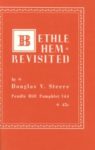
144. Bethlehem Revisited (Christmas Sermon in Germantown Unitarian Church 12/20/64; by Douglas V. Steere; 1965)
Pamphlet Quotes:
Carmelite Christmas Prayer: “May the fierce love of Jesus drive out of us all vapid and shallow peace. With wild joy and a plea for prayers, Yours, Father William.”
Jan Ruysbroeck: “All [Jesus] was & all that he had he gave; & all that we are & all that we have, he takes.”
[Frozen Christian (by Angelius Silesius)—“Bloom, frozen Christian, bloom./ May stands before thy door.”
About the Author---Douglas Steere was Professor of Philosophy at Haverford, author of: Prayer & Worship; On Beginning from Within; On Listening to one Another, Dimensions of Prayer. His concern for inner life is fused with concern for action; with his wife, Dorothy, he has gone on missions to Africa, Europe, & Asia for American Friends Service Committee (AFSC). He attended Vatican Council shortly before giving this sermon.
Christmas is a Time when we are invited to revisit Bethlehem & to reconsider its miracle. We change & our eyes change, rather than Bethlehem changing. It is a small Jordanian town of some 6,000 inhabitants, barely 5 miles south of Jerusalem. It is at 2,500 feet & yet it sits in a valley; sheep and goats share the streets with cars.
The spot where Jesus was born was probably a grotto or cave; today, this is under a vast church & a cluster of religious houses. It is shared by the Greek Orthodox, Armenian Christian, & Roman Catholic Churches. [For] the original scene we must see [the cave], the oxen & donkeys, tethered in their stalls. A young woman has given birth to her first child [there on the straw]; he now lays in a manger. Francis of Assisi reenacted this scene in an Italian barn on Christmas Eve. The saints who have lived with wild animals which terrify most folk have fearlessness from baptism into the peaceable kingdom. Francis preached his Christmas sermon from a barn floor.
Selma Lagerlof wrote Christ Legends, [and in particular] “The Wise Man’s Well.” Three Wise Men are drawn by their common vision of a rapturously beautiful star that bids them seek a newborn King. But [when] they follow the star to a grotto [they look in and] see only a young peasant woman and her husband with a new-born child. They turn away in disappointment, [which turns into dismay] when they lose the star and their memories, [and then] guilt when they know they have let their earthly judgment to lead them astray. One of them, wishing to quench his thirst [at an old well], finds in its depths the reflected image of the lost star, and [rediscovers it in the sky]. They are led back and give homage to the hidden king.
The well in which that wise man found the star was surely his own heart's inner Bethlehem. When in stubborn self-will you refuse direction & lose the star of rapture, you can recover your direction only by looking into the inward well of your own heart. If God was consumed with love & knew that only by love could humans & God’s world of nature live peaceably together, how would God communicate [God’s knowledge]? I can't see the [birth &] life of Jesus as other than God trying to disclose God’s love for us and to show that the cosmos is grounded in love. God chose to let this cosmic message shine through the material envelope of a human life.
There is a Zoroastrian legend, that pre-extent souls of men were given the [chance] to go down to earth “to do battle with the Lie.” In none of Jesus’ life is there a contempt for matter, [as there is in other religions]. Rather we see a man who draws matter together as he turns God-ward at each moment of decision. The actual Lie with which battle is to be done is two-fold: the repudiation of matter, [& rejecting it from the spirit] to purify the spirit; & the attempt to make matter & its patterning all that there is. The struggle that Hinduism & Buddhism are having with the technological revolution comes from their denial of any genuine reality to matter & trying to purify themselves from any trace of it. The Lie the West has to deal with is that matter is all there is.
Jesus not only worked within the natural process but he respected it. He hallowed [matter and natural law] by showing how one’s faith affects the way one’s body responds to surgical and chemical treatment. Every scientific step forward, the universe reveals itself as being governed by the same laws that govern human thinking. This fits Jesus’ world, where matter and its laws have a legitimate and significant status. Sir Arthur Eddington suggests that important as causal law may be, it does not exhaust the situation; all causality might have been an aspect of a deeper purpose. We may all participate in the process of luring the cosmos toward love.
As we sit on the Wise Man’s Well, the Son of Man discloses to us a further insight into the human species: Love and salvation to which Jesus draws all men is not solitary but is in community [and is universal]. As Charles Peguy said: “We must be saved together, we must come to God together.” Jesus’ command to share the good news of the God of love with all the world is a universalism of caring that breaks every last bond.
In Pope John XXIII’s vision, this inclusive spirit is no longer the exception but is a sustained attempt to reach beyond all boundaries. [John XXIII puts this spirit into practices, including visiting and embracing murderers in prison]. He also longed to witness to those in no religious group whatever. John wanted the Catholic Church to realize that Jesus brought the news that Love was the ground of the universe to all.
The Swiss Ambassador to India declared that only [through] Christianity’s most open and receptive dialogue with Hinduism, will it find what the Holy Ghost has to teach it through such an encounter. I received a Christmas note from Carmelite friends in Arizona. [It included a prayer which I put at the beginning of this summary. Douglas Steere closed by quoting Jan Ruysbroeck, also found at the beginning].
Pamphlet Quotes:
Carmelite Christmas Prayer: “May the fierce love of Jesus drive out of us all vapid and shallow peace. With wild joy and a plea for prayers, Yours, Father William.”
Jan Ruysbroeck: “All [Jesus] was & all that he had he gave; & all that we are & all that we have, he takes.”
[Frozen Christian (by Angelius Silesius)—“Bloom, frozen Christian, bloom./ May stands before thy door.”
About the Author---Douglas Steere was Professor of Philosophy at Haverford, author of: Prayer & Worship; On Beginning from Within; On Listening to one Another, Dimensions of Prayer. His concern for inner life is fused with concern for action; with his wife, Dorothy, he has gone on missions to Africa, Europe, & Asia for American Friends Service Committee (AFSC). He attended Vatican Council shortly before giving this sermon.
Christmas is a Time when we are invited to revisit Bethlehem & to reconsider its miracle. We change & our eyes change, rather than Bethlehem changing. It is a small Jordanian town of some 6,000 inhabitants, barely 5 miles south of Jerusalem. It is at 2,500 feet & yet it sits in a valley; sheep and goats share the streets with cars.
The spot where Jesus was born was probably a grotto or cave; today, this is under a vast church & a cluster of religious houses. It is shared by the Greek Orthodox, Armenian Christian, & Roman Catholic Churches. [For] the original scene we must see [the cave], the oxen & donkeys, tethered in their stalls. A young woman has given birth to her first child [there on the straw]; he now lays in a manger. Francis of Assisi reenacted this scene in an Italian barn on Christmas Eve. The saints who have lived with wild animals which terrify most folk have fearlessness from baptism into the peaceable kingdom. Francis preached his Christmas sermon from a barn floor.
Selma Lagerlof wrote Christ Legends, [and in particular] “The Wise Man’s Well.” Three Wise Men are drawn by their common vision of a rapturously beautiful star that bids them seek a newborn King. But [when] they follow the star to a grotto [they look in and] see only a young peasant woman and her husband with a new-born child. They turn away in disappointment, [which turns into dismay] when they lose the star and their memories, [and then] guilt when they know they have let their earthly judgment to lead them astray. One of them, wishing to quench his thirst [at an old well], finds in its depths the reflected image of the lost star, and [rediscovers it in the sky]. They are led back and give homage to the hidden king.
The well in which that wise man found the star was surely his own heart's inner Bethlehem. When in stubborn self-will you refuse direction & lose the star of rapture, you can recover your direction only by looking into the inward well of your own heart. If God was consumed with love & knew that only by love could humans & God’s world of nature live peaceably together, how would God communicate [God’s knowledge]? I can't see the [birth &] life of Jesus as other than God trying to disclose God’s love for us and to show that the cosmos is grounded in love. God chose to let this cosmic message shine through the material envelope of a human life.
There is a Zoroastrian legend, that pre-extent souls of men were given the [chance] to go down to earth “to do battle with the Lie.” In none of Jesus’ life is there a contempt for matter, [as there is in other religions]. Rather we see a man who draws matter together as he turns God-ward at each moment of decision. The actual Lie with which battle is to be done is two-fold: the repudiation of matter, [& rejecting it from the spirit] to purify the spirit; & the attempt to make matter & its patterning all that there is. The struggle that Hinduism & Buddhism are having with the technological revolution comes from their denial of any genuine reality to matter & trying to purify themselves from any trace of it. The Lie the West has to deal with is that matter is all there is.
Jesus not only worked within the natural process but he respected it. He hallowed [matter and natural law] by showing how one’s faith affects the way one’s body responds to surgical and chemical treatment. Every scientific step forward, the universe reveals itself as being governed by the same laws that govern human thinking. This fits Jesus’ world, where matter and its laws have a legitimate and significant status. Sir Arthur Eddington suggests that important as causal law may be, it does not exhaust the situation; all causality might have been an aspect of a deeper purpose. We may all participate in the process of luring the cosmos toward love.
As we sit on the Wise Man’s Well, the Son of Man discloses to us a further insight into the human species: Love and salvation to which Jesus draws all men is not solitary but is in community [and is universal]. As Charles Peguy said: “We must be saved together, we must come to God together.” Jesus’ command to share the good news of the God of love with all the world is a universalism of caring that breaks every last bond.
In Pope John XXIII’s vision, this inclusive spirit is no longer the exception but is a sustained attempt to reach beyond all boundaries. [John XXIII puts this spirit into practices, including visiting and embracing murderers in prison]. He also longed to witness to those in no religious group whatever. John wanted the Catholic Church to realize that Jesus brought the news that Love was the ground of the universe to all.
The Swiss Ambassador to India declared that only [through] Christianity’s most open and receptive dialogue with Hinduism, will it find what the Holy Ghost has to teach it through such an encounter. I received a Christmas note from Carmelite friends in Arizona. [It included a prayer which I put at the beginning of this summary. Douglas Steere closed by quoting Jan Ruysbroeck, also found at the beginning].
http://www.pendlehill.org/product-category/pamphlets
www.facebook.com/pendlehill?fref=ts

253. Tempted by Happiness: Kazantzakis Post-Christian Christ (by Peter Bien; 1984) About the Author—Peter Bien is Professor of English at Dartmouth College. Born in NYC in 1930, he was educated at Deerfield Academy, Harvard, Haverford, Bristol (England) & Columbia. Quakerism began at Haverford, Weekend Workcamps & Quaker International Voluntary Service. He met Greek Chrysanthi Yiannakou at Woodbrooke in England. This meeting led to marriage & extended stays in Greece. This pamphlet grows out of book Peter Bien is writing & more directly a PH extension course held by Mary Morrison on Gospel passages used by Kazantzakis.
[Introduction]—Aside from Zorba the Greek, The Last Temptation is Kazantzakis’ best known work. It is also one of his final statements. Condemnations of it come from religious conservatives of various faiths. They were scandalized by themes such as Jesus’ desire for sex, Mary’s hope that her son would remain a carpenter, & Judas’ role as a hero rather than a villain. There is no responsible study of Kazantzakis’ novel in relation to the Gospels. As literary scholar, I examined the book to see what it is about, its governing structures, & large underlying movements. The Last Temptation should be judged [by the answer to the question:] Why did Kazantzakis write it the way he did, when he did? We have the sketchbook used in preparation for writing this book. He sketched a 4-fold scheme which he did followed: “Son of the Carpenter; Son of Man; Son of David; & Son of God.” He also used the scheme of: “individual unconscious; collective unconscious; universal unconscious.
Governing Structures:
1. Son of the Carpenter Individual unconscious (Freud) biological unconscious
2. Son of Man (meek) Collective unconscious (Jung) ethical unconscious
3. Son of David (fierce) Collective unconscious (Jung) ethical unconscious
4. Son of God (PAST death) Universal unconscious (Christ) religious unconscious
www.facebook.com/pendlehill?fref=ts
253. Tempted by Happiness: Kazantzakis Post-Christian Christ (by Peter Bien; 1984) About the Author—Peter Bien is Professor of English at Dartmouth College. Born in NYC in 1930, he was educated at Deerfield Academy, Harvard, Haverford, Bristol (England) & Columbia. Quakerism began at Haverford, Weekend Workcamps & Quaker International Voluntary Service. He met Greek Chrysanthi Yiannakou at Woodbrooke in England. This meeting led to marriage & extended stays in Greece. This pamphlet grows out of book Peter Bien is writing & more directly a PH extension course held by Mary Morrison on Gospel passages used by Kazantzakis.
[Introduction]—Aside from Zorba the Greek, The Last Temptation is Kazantzakis’ best known work. It is also one of his final statements. Condemnations of it come from religious conservatives of various faiths. They were scandalized by themes such as Jesus’ desire for sex, Mary’s hope that her son would remain a carpenter, & Judas’ role as a hero rather than a villain. There is no responsible study of Kazantzakis’ novel in relation to the Gospels. As literary scholar, I examined the book to see what it is about, its governing structures, & large underlying movements. The Last Temptation should be judged [by the answer to the question:] Why did Kazantzakis write it the way he did, when he did? We have the sketchbook used in preparation for writing this book. He sketched a 4-fold scheme which he did followed: “Son of the Carpenter; Son of Man; Son of David; & Son of God.” He also used the scheme of: “individual unconscious; collective unconscious; universal unconscious.
Governing Structures:
1. Son of the Carpenter Individual unconscious (Freud) biological unconscious
2. Son of Man (meek) Collective unconscious (Jung) ethical unconscious
3. Son of David (fierce) Collective unconscious (Jung) ethical unconscious
4. Son of God (PAST death) Universal unconscious (Christ) religious unconscious
There is also a process of moving from happiness to increasing meaningfulness, and a process of increasing dematerialization.
THE 4-FOLD SCHEME: 1. Son of the Carpenter—This rubric signifies Jesus as ordinary; as a typical person seeking a living, marriage, reproducing and respect, [i.e.] happiness. The conflict between happiness and meaningfulness, [is a key concern for Kazantzakis]. [He sees most of us] rejecting the “inhuman” call of God to be unhappy, to struggle, to move beyond ego, sex and prosperity toward a [meaningful], ethically directed life and eventually a spiritually directed one. Kazantzakis wants us to move beyond the pleasure principle.
In the novel, Mary wants her son cured. She says, “I want my son a man like everyone else, nothing more, nothing less ... Let him build … Let him marry ... Let him be a provider have children.” Jesus seems driven to be abnormal, unhappy, even though he attempts to resist the call to spirituality. Freudian wisdom says that religious fanatics need only marry and they will grow calm. [Jesus is encouraged to get married and calm down]. Kazantzakis’ point is that this kind of calm must be transcended. The last temptation of the novel [is met] by Jesus refusing to regress to Son of the Carpenter, reaffirming his choice of a meaningful life over a merely happy one.
2. Son of Man—This rubric is more difficult than Son of the Carpenter. Kazantzakis takes the term from Dan. 7:13-14. Daniel’s vision is read out loud in scene which forms watershed between Jesus’ old existence as Son of the Carpenter, & his new existence as Son of Man. [He has taken on vocation of] toiling for everyone’s salvation. He passes into Jung’s collective unconscious; he exhorts his fellows to be righteous & [loving &] come into unity.
3. Son of David—This 3rd stage seems strangely regressive, a retreat. Jesus has a more limited vocation as Son of David. This Jesus advocates revolutionary politics preached by Judas. How can we accept a Jesus who wishes to employ evil in order to destroy evil? Kazantzakis turns Jesus into fiery reformer preaching violence because he wishes to make 2 important points. Politically, the best way to succeed is to fail. In the novel Kazantzakis grants Jesus Christ no political successes. Material failure of his meekly preaching peace & unity prevents a greater spiritual failure, opening the way to spiritual evolution. He evolves by collaborating with the devil.
Psychologically, Kazantzakis desires not happiness but integration. Being integrated means [even Jesus] recognizing & accepting human nature’s evil part. The psychologically sound individual channels evil into the service of the good. This is what Jesus does when he becomes Son of David. [In the novel], Judas becomes spokesman for Zealots, & a projection of Jesus’ own demonic nature. Jesus must come to love & literally embrace Judas since this is the outward sign of embracing his own demonic depths. In order to earn right to preach love, he must integrate his angelic & devilish sides. Only when this integration is accomplished can our hero move beyond.
4. Son of God—In this 4th and final stage, Kazantzakis seems to be thinking of Paul’s definition in Romans 1:4. Son of God is only achieved in death. In the novel’s final section Jesus becomes devoted to self-extinction. Failure of Jesus’ naive, pacifistic, spirituality, led to political militancy; failure of political militancy led to an apolitical “detachment” which at the same time is the basis for his ultimate power in the world. By willing his own crucifixion he brings death into the service of good. [In the Son of God there is] an infinite hope that goodness will be established sometime in the future.
Jesus, after being wounded by human experience, arrives at oneness with a consciousness beyond individual or collective, a universal consciousness. God, for Kazantzakis, means pure spirit, creative force in its disembodied essence. Jesus in the final phase deliberately wills to become dematerialized, “to unite with God.”
(See earlier section on Governing Structure) Jesus deliberately cooperates with universal process (“God”) rather than resist it or pretend it doesn’t exist. The Last Temptation is about evolution toward dematerialization. The spirit that drives Jesus toward his goal is a dynamic & cyclical creativity which, [when dematerialized], will re-embody itself & start the process anew. The novel’s last words are “Everything is begun.”
KAZANTZAKIS’ FINAL STATEMENT—Kazantzakis had arrived at serenity through an evolution similar to Jesus’, having willed himself into ethical and collective struggles, only to fail repeatedly to make the world a better place. Kazantzakis longed eagerly toward the end of his career to make his way out of time as a new kind of power that would accomplish in the future what he had so far failed to accomplish in life. He wrote the book to universalize his experience of aspiration and failure leading to hope despite that failure. He at this final stage of his career was deliberately willing himself into a kind of immateriality. He had fought many political battles and had lost them all, most recently on the losing side of the Greek Civil War. While there was bitterness, another part of him was hopeful. He wrote: “At the bottom of this corruption there is a virgin soul that is sprouting ... that one day ... will triumph. A Messiah is always on the march.” He believed that his own struggles and failures were producing in him a harmony that lay beyond the vicissitudes of life in the body. He was willing himself into a religious attitude rather than a biological or ethical one.
Kazantzakis didn’t believe that an everlasting kingdom would replace this one, but that this kingdom would, through dematerialization, produce its own renewal in another cycle. The important things was to keep the spirit alive between cycles. [In his writing], Kazantzakis wanted to remain a disembodied voice emerging out of [the world’s horrors], the end of a cycle. [Even though] “humanity is at the brink of the abyss ... Man must act as though he were immortal.” [With this statement in mind], Kazantzakis sat down & wrote this story in which Jesus moves from ordinariness to vocation, sees his political & ethical hopes destroyed, & ends his life with freely willing dematerialization & [end-of-the-age] hope, acting as though he were immortal. By keeping Christ’s model alive in our hearts & minds between one cycle’s end and the next one’s birth, he hoped he would “aid future man to be born one hour sooner, one drop more integrally. Kazantzakis leaves us with his faith in young people who will move from ordinariness to vocation; who collaborate with the devil to avoid stagnating; who will, [even with unfulfilled dreams] continue to act as though they were immortal, believing in the spirit’s abiding power.
THE 4-FOLD SCHEME: 1. Son of the Carpenter—This rubric signifies Jesus as ordinary; as a typical person seeking a living, marriage, reproducing and respect, [i.e.] happiness. The conflict between happiness and meaningfulness, [is a key concern for Kazantzakis]. [He sees most of us] rejecting the “inhuman” call of God to be unhappy, to struggle, to move beyond ego, sex and prosperity toward a [meaningful], ethically directed life and eventually a spiritually directed one. Kazantzakis wants us to move beyond the pleasure principle.
In the novel, Mary wants her son cured. She says, “I want my son a man like everyone else, nothing more, nothing less ... Let him build … Let him marry ... Let him be a provider have children.” Jesus seems driven to be abnormal, unhappy, even though he attempts to resist the call to spirituality. Freudian wisdom says that religious fanatics need only marry and they will grow calm. [Jesus is encouraged to get married and calm down]. Kazantzakis’ point is that this kind of calm must be transcended. The last temptation of the novel [is met] by Jesus refusing to regress to Son of the Carpenter, reaffirming his choice of a meaningful life over a merely happy one.
2. Son of Man—This rubric is more difficult than Son of the Carpenter. Kazantzakis takes the term from Dan. 7:13-14. Daniel’s vision is read out loud in scene which forms watershed between Jesus’ old existence as Son of the Carpenter, & his new existence as Son of Man. [He has taken on vocation of] toiling for everyone’s salvation. He passes into Jung’s collective unconscious; he exhorts his fellows to be righteous & [loving &] come into unity.
3. Son of David—This 3rd stage seems strangely regressive, a retreat. Jesus has a more limited vocation as Son of David. This Jesus advocates revolutionary politics preached by Judas. How can we accept a Jesus who wishes to employ evil in order to destroy evil? Kazantzakis turns Jesus into fiery reformer preaching violence because he wishes to make 2 important points. Politically, the best way to succeed is to fail. In the novel Kazantzakis grants Jesus Christ no political successes. Material failure of his meekly preaching peace & unity prevents a greater spiritual failure, opening the way to spiritual evolution. He evolves by collaborating with the devil.
Psychologically, Kazantzakis desires not happiness but integration. Being integrated means [even Jesus] recognizing & accepting human nature’s evil part. The psychologically sound individual channels evil into the service of the good. This is what Jesus does when he becomes Son of David. [In the novel], Judas becomes spokesman for Zealots, & a projection of Jesus’ own demonic nature. Jesus must come to love & literally embrace Judas since this is the outward sign of embracing his own demonic depths. In order to earn right to preach love, he must integrate his angelic & devilish sides. Only when this integration is accomplished can our hero move beyond.
4. Son of God—In this 4th and final stage, Kazantzakis seems to be thinking of Paul’s definition in Romans 1:4. Son of God is only achieved in death. In the novel’s final section Jesus becomes devoted to self-extinction. Failure of Jesus’ naive, pacifistic, spirituality, led to political militancy; failure of political militancy led to an apolitical “detachment” which at the same time is the basis for his ultimate power in the world. By willing his own crucifixion he brings death into the service of good. [In the Son of God there is] an infinite hope that goodness will be established sometime in the future.
Jesus, after being wounded by human experience, arrives at oneness with a consciousness beyond individual or collective, a universal consciousness. God, for Kazantzakis, means pure spirit, creative force in its disembodied essence. Jesus in the final phase deliberately wills to become dematerialized, “to unite with God.”
(See earlier section on Governing Structure) Jesus deliberately cooperates with universal process (“God”) rather than resist it or pretend it doesn’t exist. The Last Temptation is about evolution toward dematerialization. The spirit that drives Jesus toward his goal is a dynamic & cyclical creativity which, [when dematerialized], will re-embody itself & start the process anew. The novel’s last words are “Everything is begun.”
KAZANTZAKIS’ FINAL STATEMENT—Kazantzakis had arrived at serenity through an evolution similar to Jesus’, having willed himself into ethical and collective struggles, only to fail repeatedly to make the world a better place. Kazantzakis longed eagerly toward the end of his career to make his way out of time as a new kind of power that would accomplish in the future what he had so far failed to accomplish in life. He wrote the book to universalize his experience of aspiration and failure leading to hope despite that failure. He at this final stage of his career was deliberately willing himself into a kind of immateriality. He had fought many political battles and had lost them all, most recently on the losing side of the Greek Civil War. While there was bitterness, another part of him was hopeful. He wrote: “At the bottom of this corruption there is a virgin soul that is sprouting ... that one day ... will triumph. A Messiah is always on the march.” He believed that his own struggles and failures were producing in him a harmony that lay beyond the vicissitudes of life in the body. He was willing himself into a religious attitude rather than a biological or ethical one.
Kazantzakis didn’t believe that an everlasting kingdom would replace this one, but that this kingdom would, through dematerialization, produce its own renewal in another cycle. The important things was to keep the spirit alive between cycles. [In his writing], Kazantzakis wanted to remain a disembodied voice emerging out of [the world’s horrors], the end of a cycle. [Even though] “humanity is at the brink of the abyss ... Man must act as though he were immortal.” [With this statement in mind], Kazantzakis sat down & wrote this story in which Jesus moves from ordinariness to vocation, sees his political & ethical hopes destroyed, & ends his life with freely willing dematerialization & [end-of-the-age] hope, acting as though he were immortal. By keeping Christ’s model alive in our hearts & minds between one cycle’s end and the next one’s birth, he hoped he would “aid future man to be born one hour sooner, one drop more integrally. Kazantzakis leaves us with his faith in young people who will move from ordinariness to vocation; who collaborate with the devil to avoid stagnating; who will, [even with unfulfilled dreams] continue to act as though they were immortal, believing in the spirit’s abiding power.
http://www.pendlehill.org/product-category/pamphlets
www.facebook.com/pendlehill?fref=ts


Comments
Post a Comment